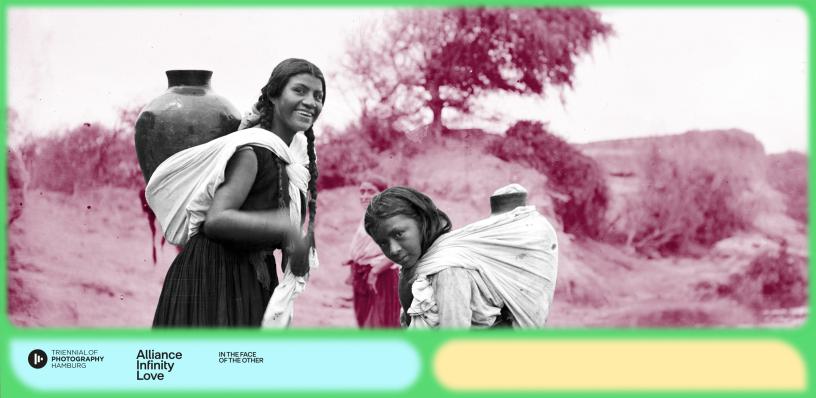
Intimate portraits, scenes from everyday life and documentary images – the historical photographs and musical recordings made by Hans Heinrich Brüning (1848–1929) continue to resonate strongly in Peru, opening up new perspectives on identity, memory and cultural self-determination. The German amateur researcher assembled a multimedia collection over five decades in the Lambayeque region, documenting local life and cultural history with great dedication.
This collaboratively curated exhibition brings together reappropriations by local practitioners, academics and artists who transform these colonially shaped documents into living archives. Afro-Peruvian and queer interpretations form just as much a part of the dialogue as the artistic photo-ceramics by Enzo Miguel Matute or the embroidered interventions by Marystela Camacho.
In the digital age, new forms of appropriation and participation are also emerging as communities rework historical images and music online. The exhibition shows how Brüning’s collections continue to echo through communities and connect people across generations and borders.
In collaboration with Prof. Gisela Cánepa (Pontificia Universidad Católica del Peru) and Dr Walther Maradiegue (Rheinische Friedrich-Wilhelms-University of Bonn), the exhibition highlights processes of cultural reappropriation that go beyond the boundaries of the museum archive.